30 Instagram post ideas for coaches who hate posting
A month of posts for coaches and consultants: what to say, in what order, and why the boring-looking ones are the posts that actually get people to book.
5 min readUpdated · free to read, no sign-up
The reason posting feels heavy is rarely design. It is opening the app with nothing decided. A month planned in one sitting takes about an hour and removes that decision thirty times over.
Below is a month that works for coaches, therapists and consultants — anyone selling their own judgement. It is built on a simple rotation: teach, prove, show yourself, ask. Repeat weekly, and the account stops sounding like a brochure.
Week one — teach something small
- One mistake you see clients make in their first session.
- A term from your field explained in plain words.
- The question you ask that people find hardest to answer.
- A two-minute exercise someone can do before they ever hire you.
- What you would do first if you were starting over from nothing.
- A myth in your industry that costs people money.
- Something you changed your mind about in the last year.
Week two — prove it works
- A before and after, with the timeline stated honestly.
- One sentence a client said that you think about often.
- The result nobody expected — including you.
- What a session actually looks like, minute by minute.
- A screenshot of a message you were allowed to share.
- The kind of client you are not a fit for, and why.
- A number: how many people, how long, how much changed.
- A case where the fix turned out smaller than the client expected.
Week three — be a person
- Why you started doing this work.
- The part of the job you find hardest.
- Your actual desk, unstaged.
- A book, podcast or paper that changed how you practise.
- What you do when you are the one who is stuck.
- A boundary you had to learn to hold.
- Something you are still bad at.
Week four — ask for the work
- What you offer, named plainly, with the price.
- Who it is for, in one sentence they would use about themselves.
- What happens in the first week of working together.
- How many spots are open and when they start.
- The objection you hear most, answered without defensiveness.
- A direct invitation: how to book, in one step.
- A recap of the month for whoever just found you.
- What people get wrong about the price, answered calmly, once.
The two rules that matter
First: one idea per post. A carousel that argues three points is three posts you have thrown away. Second: say the offer out loud at least four times a month. People who follow you are not tracking your business model — most of them genuinely do not know what you sell or what it costs.
The design job is only to make thirty different messages look like they came from the same practice. That is what a template set does: the layout is decided, so the only thing left to bring is the sentence.
Write the caption in three lines
Instagram shows about one line before the fold, so the first sentence is not an introduction — it is the whole invitation. Coaches lose most of their captions to a warm-up paragraph nobody reads: today I want to talk about, I have been thinking a lot about, as many of you know.
- 1Line one: the claim, stated flat. "Most of my clients do not have a confidence problem. They have a decision problem."
- 2Line two to four: the reason it is true, in the smallest number of words that still convinces. One example beats three assertions.
- 3Last line: the ask. Follow for more is not an ask. "If this is you, my next intake opens Monday" is.
Write the last line first if you get stuck. Knowing where a caption is going tends to shorten it by half, and a short caption on a strong post gets read to the end — which is the only reading that counts.
What to do when a post flops
Nearly always the answer is nothing. A single quiet post carries almost no information: reach on a small account swings wildly on the time of day and on who happened to open the app. Changing your strategy after one bad Tuesday is how people end up with an account that has no strategy at all.
What is worth reading is the pattern across a month. If every teaching post lands and every offer post dies, the offer is not being set up — people do not know enough about what you sell to want it, and three more offer posts will not fix that. If nothing lands at all, the problem is usually that the posts are about coaching in general rather than about a person with a specific problem.
- Saves and shares matter more than likes. A save means someone intends to come back; that is the closest thing on the platform to interest in buying.
- Profile visits after a post tell you the post made someone curious about you rather than merely entertained.
- Replies to stories are the highest-value signal a coaching account gets, and the one most people never look at.
Keep the posts that produced those, in the shape they were in, and make more of that shape. That is the entire optimisation loop, and it beats rewriting your positioning every fortnight.
Still wondering
Questions
How often should a coach post on Instagram?
Three times a week, indefinitely, beats daily for two weeks and nothing for a month. Consistency is the only variable you fully control, and the account rewards the one you can keep.
What should a coach post if they have no client results yet?
Teach the thing you would have paid for. Method, mistakes, what a session actually looks like, who it is not for. Results are proof, but process is what makes someone trust you enough to become one.
Do carousels work better than single posts for coaches?
For teaching, yes — a carousel gets saved, and saves are the signal that keeps a post circulating. Single images are for statements and offers, where you want the whole point visible without a tap.
How do I sell without every post being a pitch?
One offer post in four. The other three earn the right to make it. An account that only sells reads as an advert; an account that never sells trains people that you are free.
Should coaches show their face on Instagram?
In coaching people buy the person, so yes, more than in most niches — but it does not need to be daily. One or two personal posts a month, with the rest type-led, is enough to stop the account feeling like a brochure.
Sets from this guide
Skip the blank page
See every set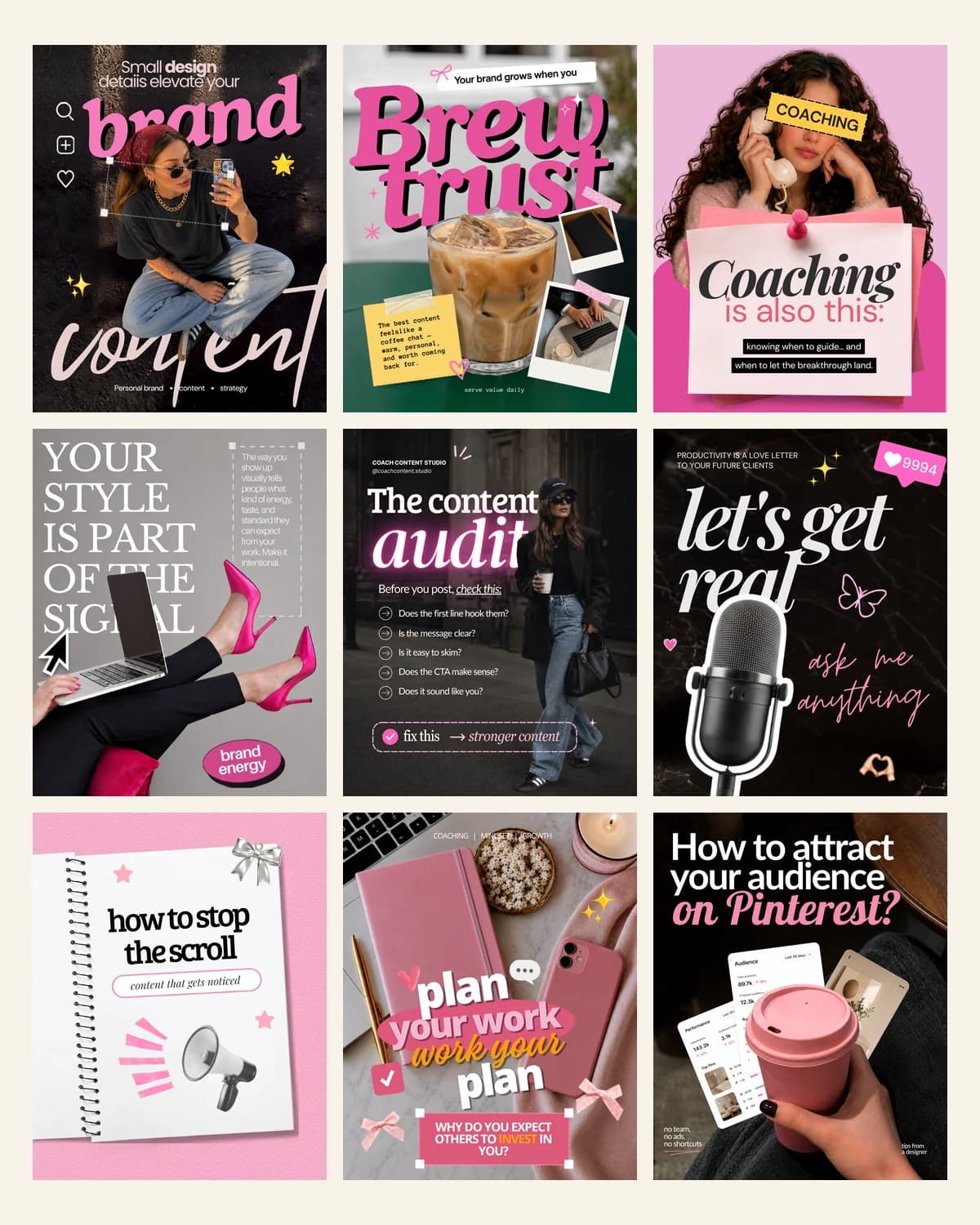
Written for
Your line of work
Keep reading