What to track when you buy and sell cars
The numbers that decide whether a flip made money: everything between the auction price and the sale price, which costs people forget, and how to know your real margin before you buy the next one.
3 min read · free to read, no sign-up
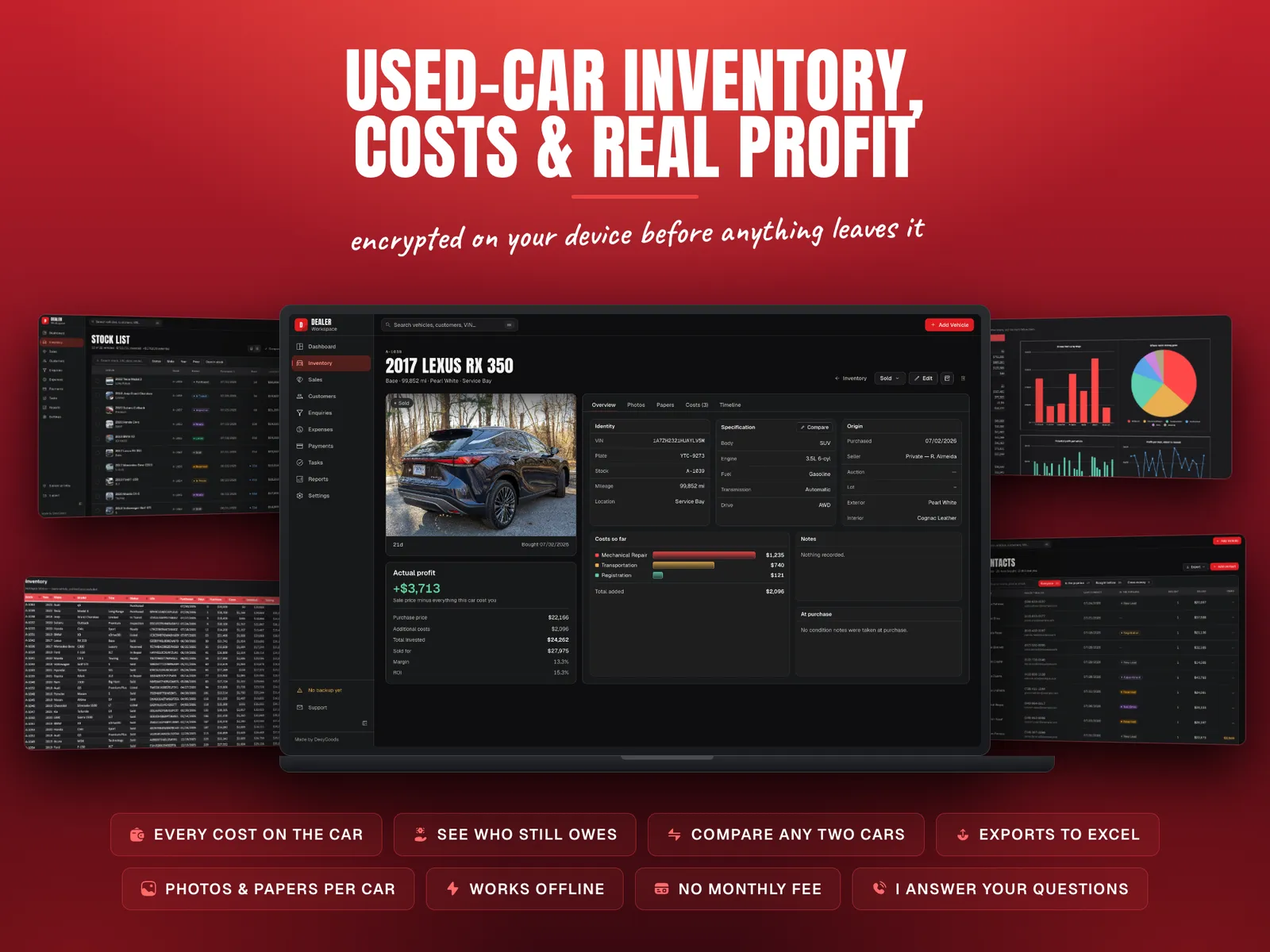
Bought at £4,200, sold at £5,400, so twelve hundred made. That is the arithmetic almost everyone starts with, and it is wrong by about half. The gap between those two numbers is where a flipping business lives or dies, and it is invisible unless it is written down at the time.
Everything between buying and selling
- Purchase price, and the buyer's fee if it came from an auction.
- Transport or collection: fuel, a trailer, a driver, a day of your own time.
- Trade insurance and tax for however long you hold it.
- Inspection, diagnostics, and the test that tells you what you actually bought.
- Parts, at what you paid, not at what they list for.
- Labour, including your own hours at a rate you would pay somebody else.
- MOT, service, and anything the test threw up.
- Valeting and photography — small, but they come off every single car.
- Advertising: the listing fee, the boosted listing, the platform's commission.
- Warranty or goodwill: whatever it costs when a buyer comes back a fortnight later.
The two most commonly forgotten
Holding time and your own hours. A car that sits for eleven weeks costs insurance, space and the money that could have been in the next one; a car that took you thirty hours at nought pounds an hour did not make the margin you think it did. Write the date bought and the date sold on every row and the pattern shows up within about six cars: certain models, certain price brackets and certain colours sit, and it is never the ones you expect.
The number worth knowing before the next auction
- 1Take the total of everything above, per car.
- 2Subtract it from the price the car actually sold for — not the price it was listed at.
- 3Divide by the days you held it. That is what the car earned per day of your money and your space.
- 4Compare cars by that number, not by the headline profit. A £600 flip in three weeks beats a £900 flip in three months.
Keep it per car, from the day you buy
One row per vehicle, with the registration and the dates, and every cost written the day it happens. Reconstructing it later never works: the receipts go missing, the hours vanish, and the number comes out flattering. A tracker that is honest about a bad flip is what stops you buying the same bad flip again.
Where the vehicles are somebody else's — a sale or return, a family member's car — the same row still applies, plus who is owed what when it sells. That is the record you will want if there is ever a disagreement about the split.
Sets from this guide
Skip the blank page
Written for
Your line of work
Keep reading