What goes on a freelance invoice — and what gets it paid faster
The fields an invoice needs to be valid, the four that decide whether it is paid this week or next month, and the follow-up wording that works without souring the relationship.
3 min read · free to read, no sign-up
Most late payment is not a client refusing to pay. It is an invoice that arrived without a purchase order number, or went to a person rather than an accounts inbox, and sat in a folder until somebody asked. Getting paid on time is mostly an admin problem, and it is solved on the invoice itself.
The fields that make it an invoice
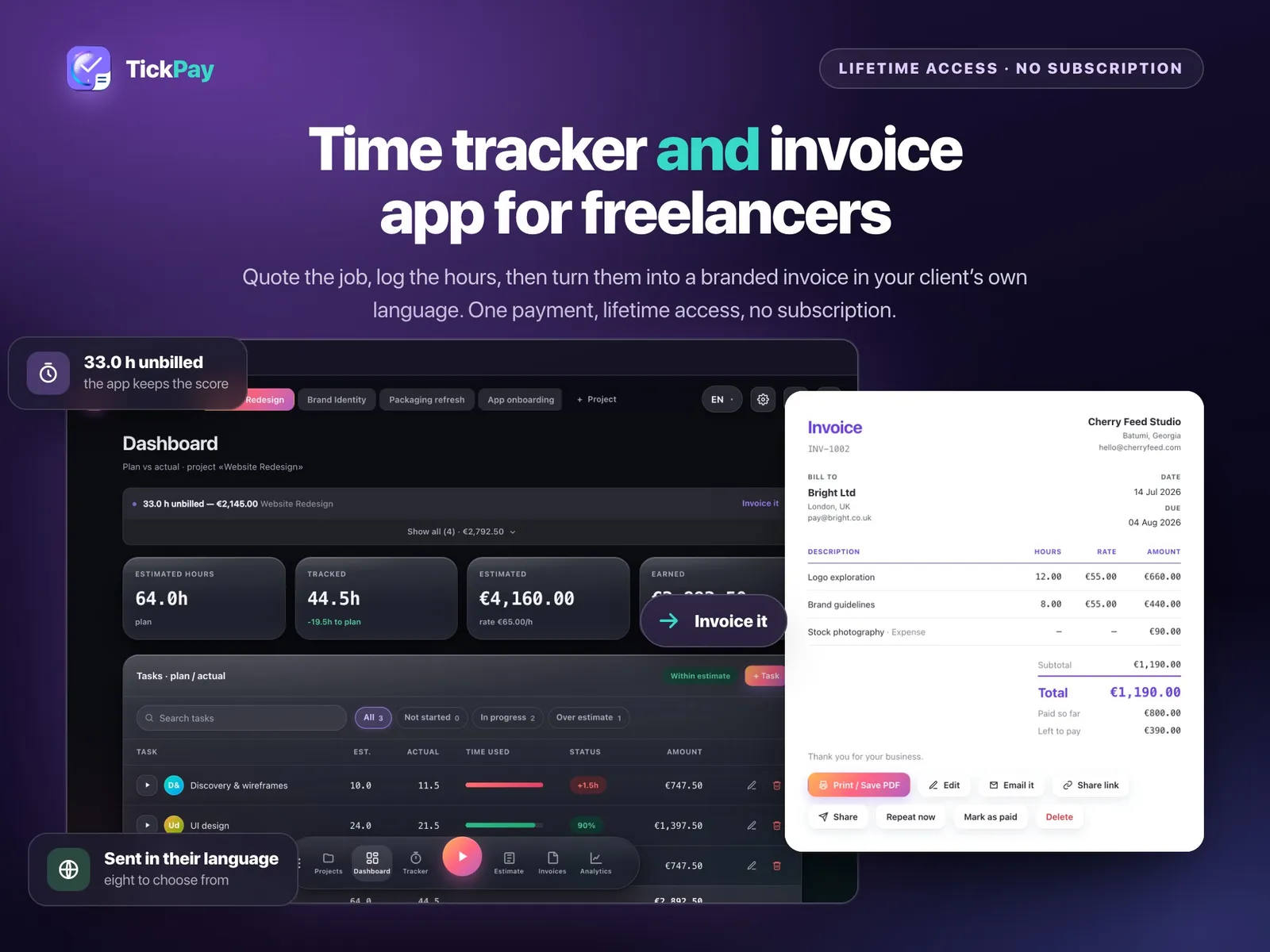
- The word "Invoice", and a unique number you never reuse. Sequential is fine; 2026-014 is easier to talk about on the phone than 47.
- Your name or trading name, address and contact details.
- The client's legal name and billing address — the company, not the person who briefed you.
- The date issued and the date payment is due, written as a date. "Net 30" is jargon to half the people who will read it.
- What you did, in the client's language, with quantities and a rate.
- The total, and any tax shown separately at the rate that applies to you.
- How to pay: account details in full, or the payment link.
Tax registration numbers, company numbers and the exact wording required on an invoice differ by country, and in some places they are a legal requirement rather than a nicety. Check what yours are once, put them in your template, and stop thinking about it.
The four things that decide when it is paid
- 1The purchase order or reference number, if the client uses them. Without it, an accounts department cannot pay you even when they want to.
- 2The right recipient. Ask during the project: "who should the invoice go to?" A copy to your contact, the original to accounts.
- 3A due date that is a real date. "Due 30 September 2026" is a deadline; "payable within 30 days" is a topic of discussion.
- 4A line of description they recognise. If the invoice says "consulting" and the budget line says "website copy", somebody has to make a phone call before it can be approved.
Chasing without souring anything
Send the first reminder the day after the due date, and make it administrative rather than emotional: "Invoice 2026-014 was due yesterday — sending it again here in case it needs a nudge. Happy to re-issue if anything on it is wrong." That last sentence does most of the work, because a stuck invoice is usually stuck on a detail nobody wanted to mention.
A second reminder a week later, addressed to accounts with your contact copied in, resolves nearly everything else. Only after that does it become a conversation about terms, and by then you have a written trail that you were reasonable at every step.
Keep a copy of every one
Numbered, dated, and in one place — with what has been paid marked against it. Two things fall out of that list for free: you can answer "what did I earn this quarter" without opening a bank statement, and you can see which client always pays late before you agree to the next project with them.
Sets from this guide
Skip the blank page

Written for
Your line of work
Keep reading