Colour stock control for a salon that keeps running out
Why the tube you need is always the missing one, how to count a colour wall without closing for an afternoon, and the reorder numbers that keep shelves lean without gambling on a Saturday.
3 min read · free to read, no sign-up
Every salon has the same two problems at once: a shelf of shades nobody has used in a year, and a Saturday client whose exact tube ran out on Friday. Both come from the same place — stock is counted by eye, and the eye counts the wall, not the shades that move.
Count what moves, not what sits
Split the wall into three groups before you count anything. The shades you use every week, the ones you use monthly, and the ones you have not touched this year. The first group is where every stock-out happens and where the money is; the third group is money already spent and worth clearing rather than counting.
You only need real numbers for the first two groups. That turns a stocktake from an afternoon into twenty minutes, which is the difference between a system you keep and one you did once.
The number that stops the Saturday problem
- 1For each regular shade, write down how many tubes you get through in a normal week.
- 2Multiply by how long an order takes to arrive, in weeks, and round up.
- 3Add one. That is your reorder point — the level at which you order, not the level at which you run out.
- 4Order back up to about three weeks of use. More than that is cash sitting on a shelf, and colour does not improve with age.
A shade you use two tubes a week of, on a one-week delivery, is reordered at three and topped back up to six. Written on the shelf edge, it needs no spreadsheet at all — the spreadsheet is for the version of you that is busy.
Track the cost per client, not the cost per tube
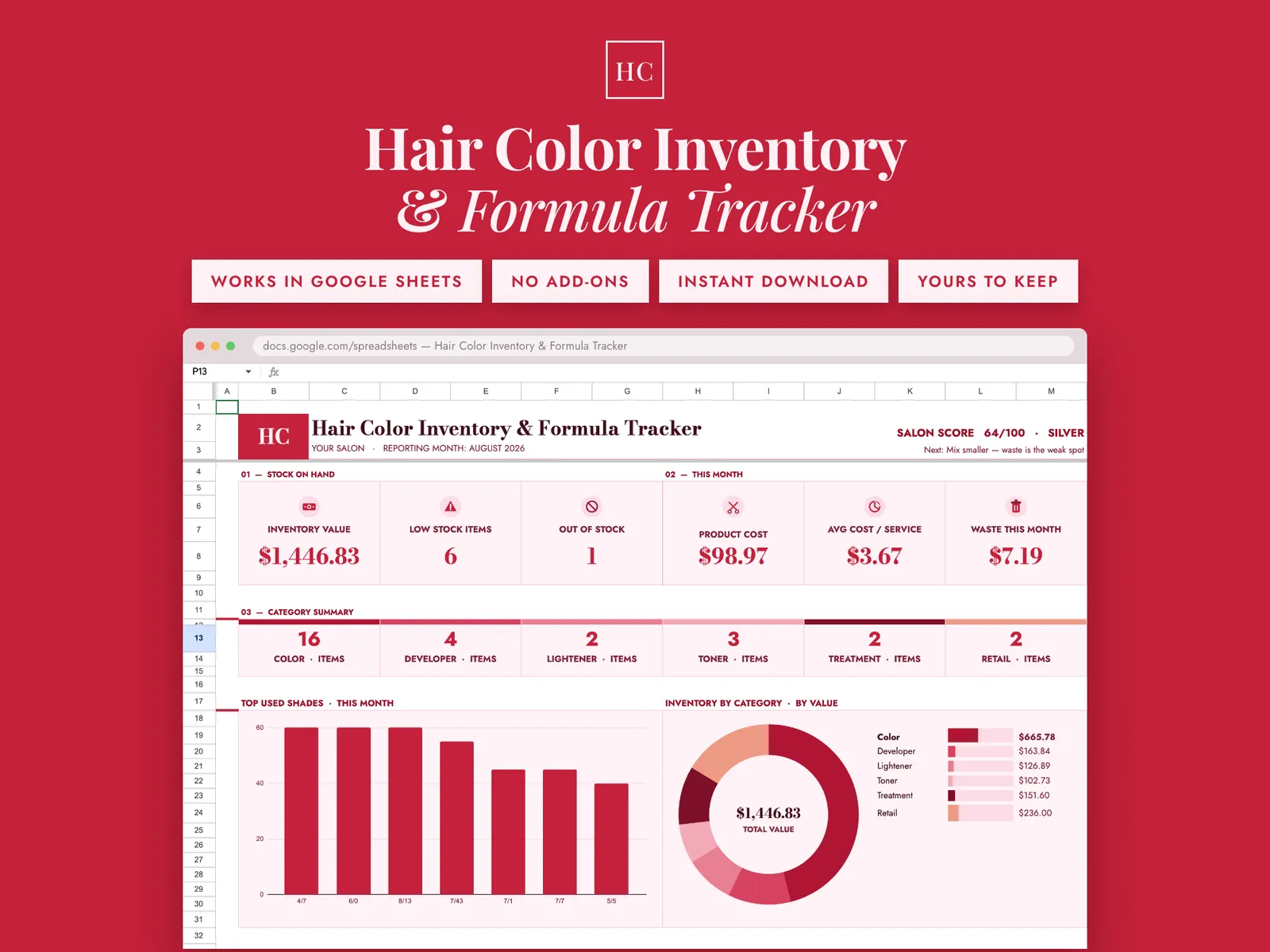
The useful number is what colour costs on a head, and it is the one almost nobody knows. Record the tube and the amount mixed against the client, and after a month you can see which services are priced properly and which long-hair full-heads are quietly costing you three times what a root touch-up does at a price that barely differs.
That is also the number to reach for when a supplier price rises. You cannot argue with a percentage; you can decide what to do when you can see that a service went from eleven pounds of colour to fourteen.
Waste, in a place you can see it
- Mixed too much: the most common and the easiest to fix, because the fix is writing down what was actually needed last time on that head.
- Bought on offer: three of a shade you use twice a year is not a saving.
- Discontinued lines kept "in case": set a date, use them on your own hair or clear them, and take the shelf back.
- Tubes with no lid, at the back, going hard. Count them once and the habit changes.
None of this needs software. It needs one list, kept where the colour is mixed, that says what you hold, what you use, and what a service costs — and five minutes on the same day each week.
Sets from this guide
Skip the blank page

Written for
Your line of work
Keep reading